



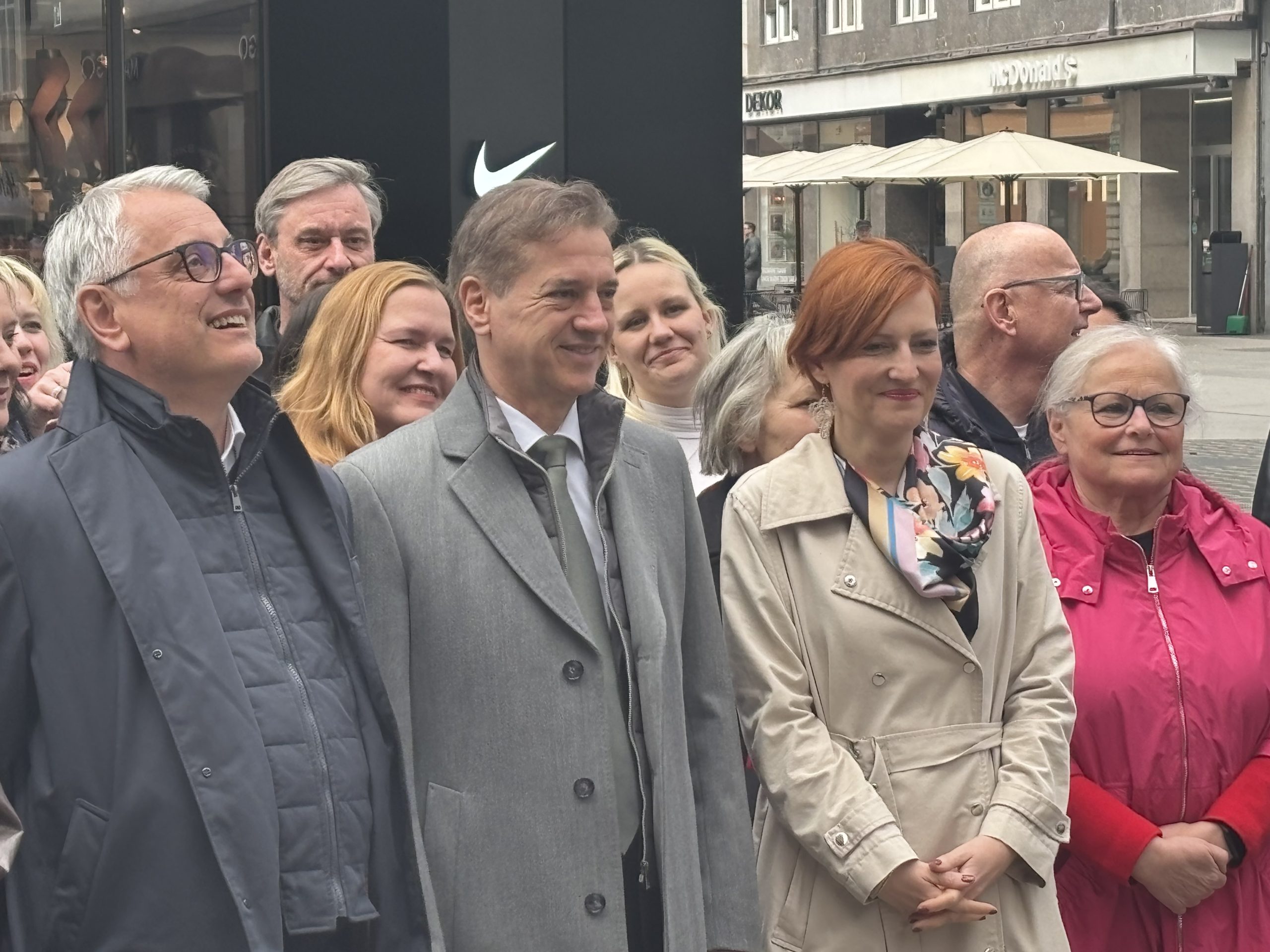
Democratic backsliding, militarisation and austerity politics have all increased with the rise of the far right in Europe; now Slovenia also follows this dominant trend. Parliamentary elections were held on March 22, and it must thus be clearly stated, that the liberal-centre-left coalition, comprised of the liberal Freedom Movement of prime minister Robert Golob, the Social Democrats, and the left party Levica, has lost both the election, and with it, its parliamentary majority. Its representation has fallen from 52 to 40 MPs, with 46 constituting a majority. It is a Pyrrhic consolation that the liberal Freedom Movement (29 MPs), despite losing the most support within the coalition, narrowly outpolled the right-wing conservatives of Janez Janša’s Slovenian Democratic Party (SDS) with 28 MPs.
The campaign itself was highly polarised and reminiscent of the US with a pro-Trumpist and neoconservative former Prime Minister Janez Janša succeeding to articulate his campaign with various toxic and vilifying attacks, disguising smear-campaigns and fake news as facts. The mass media simply followed this sensationalist campaign and helped to stage and broadcast indigestible public encounters between candidates. The incumbent government, however, bet on a moderate campaign, as if we were stuck in a time before 2015. Coalition parties ran a campaign largely defending its own record: protecting social rights, half-halting the privatisation of healthcare, improving wage agreements, raising the minimum wage and pensions, initiating a social housing system, and being a vocal critique of genocide in Gaza within EU. The majority of these socioeconomic achievements by the government were achieved by concentrated efforts of its smallest coalition partner, Levica that was running social Ministries that were devoted to these questions. Particularly the provision of social housing, previously destroyed by all political parties and big investment capital, was an important milestone for the left and a material change that really matters. Despite these initial achievements, the changes were felt only marginally by most. It should be noted that electoral battles cannot be won only if framed defensively and a pat on the back. The current government, and all its three parties, attempted to show these steps as a gradual path to larger reforms to come. What they failed to do, however, was to put forward a compelling vision, and articulate their position in countering the authoritarian right offensive.
Electoral body split into two: Orbán tactic of messing with elections
In contrast, Janez Janša and his right-wing satellites advanced with an aggressive and often cynical campaign playing on resentment infused with familiar Trumpist tropes: tax cuts for the wealthy (marketed as relief for entrepreneurs), welfare retrenchment, anti-immigrant rhetoric, a pro-militarist stance and an embrace of the genocide in Gaza. It seemed that all right-wing parties repeated one central mantra: lowering taxes can save us from all of our troubles. The result was a campaign structured less by substantive debate but rather by framing politics in a very individualistic neoliberal mindset and as an antagonistic spectacle. In this realm, those who are louder and more angry prevail over any rational choice. It needs to be said that centre-left parties were fairly successful to argue for a broader social understanding of politics, but failed to operate on the level of creating emotions.
Reconstructing the last months before elections, it should be noted that right-wing bloc entered the final stretch of campaign with a comfortable lead. Only the last two weeks pointed to a more inconclusive outcome in which the centre-left government may have still had a chance to hold onto its mandate in the next cycle. This was the strategic moment when Janez Janša deployed a final, controversial tactic: introducing Black Cube, the biggest private intelligence firm in the world, based in Israel, in what appears to have been a coordinated disinformation effort. Edited videos targeting centre-left politicians, particularly from the Social Democrats, circulated widely and alleged systemic corruption, of course only pointing out the corruption of centre-left figures. Something that was not expounded on is that the major political party of Janša, in a similar vein to Orbán and Pegasus, has been involved in many corruption cases and collaborated with foreign private intelligence service to meddle in the elections. The sad picture that was instead being painted was of the alleged corruptive of the centre-left. Thus, in the final days leading up to the election, substantive campaigning gave way entirely to scandals and orchestrated outrage. Mainstream outlets amplified this dynamic, reproducing polarising narratives with little scrutiny. Public discourse collapsed into typical antipolitical noise, marked by paranoia and mutual accusations across the political spectrum. A small chaos that only a grand leader can save us from.
This atmosphere was further intensified by broader geopolitical tensions—most notably the ongoing US–Israeli war against Iran—which fed into domestic anxieties around security and energy. Reports and experiences of fuel shortages at petrol stations (and suspicions surrounding the conduct of the country’s main supplier, Petrol, that had already openly supported Janša’s campaign) worsened the sense of instability. For older generations, such scenes evoked memories of late Yugoslav austerity, reactivating latent nationalist reflexes. Affective drivers like fear, insecurity, and anger are central to contemporary authoritarian populism. In many respects these titled the election and pushed not only older male, but also young voters, to the right of the political spectrum in Slovenia. This is not exceptional and could be compared to various far right tendencies across Europe.
The parliamentary arithmetic now reflects this shift. Turnout was slightly above average, 68% of people came out to vote. Results show that the former governing coalition holds 40 MPs: Golob’s liberal Freedom Movement with 29, the Social Democrats with 6, and Levica/Vesna with 5 mandates. The right-wing bloc commands with 43 MPs: Janšas neo-conservative SDS with 28, the religious-conservative Christian party New Slovenia with 9, and the Democrats, who are widely seen as Janša’s proxy party, with 6 mandates. The remaining seats include two minority representatives (Italian and Hungarian) and a newcomer: the rightwing neoliberal and populist party Resnica (Truth), which has entered parliament with five MPs. Resnica is ideologically volatile, combining hard neoliberalism, anti-vaccination positions, and anti-establishment rhetoric positioning itself outside the traditional left-right divide, yet remains a more likely partner for a right-wing coalition. One can openly wonder, if its pre-electoral public oath not to enter a government with Janez Janša was not a part of its well-thought-out tactic to make themselves slightly different than other right-wing parties.
What is to be done? New elections!?
If such a right-wing coalition manages to form, it would likely entail a rapid dismantling of recent socio-economic gains, lowering taxes, especially for the rich, intensified attacks on public institutions in culture, media, and education, and an alignment with militarised, pro-war policies around the world evoking Huntingtonian Clash of Civilisation.
An alternative scenario would see the current ruling party Freedom attempt to form a government. This could happen either with Resnica, at the cost of chronic instability, or, the more likely scenario, by peeling away smaller right-wing actors from Janša’s bloc (New Slovenia and/or Democrats). This could result in a «national unity» government, potentially excluding Levica/Vesna, and initiating a slower but still decisive erosion of social achievements and return to more open neoliberal agenda. In strategic terms, these options favour Janša’s new advent on power: indirect influence within the government (Trojan horse) and continued dominance in the opposition. With these prospects, he could prepare the grounds for early elections under even more favorable conditions.
From the perspective of the centre-left, the outcome is unequivocally a defeat, both materially and symbolically. None of the available coalition configurations offers stability or coherence; they all point toward fragmentation, uncertainty, and a likely governmental crisis. In this context, the least damaging option may be to insist on the current constellation and afterwards call for new elections, allowing political alignments to crystallize more clearly. For the centre-left, this would necessitate a fundamentally reworked strategy, one capable of articulating not merely a defence of past achievements, but a credible and mobilising vision for the future.
For the left, this moment is more than ripe for a strategic and critical re-evaluation rather than a return to the business as usual. Especially if no new elections are called due to failed attempts to form a new coalition, the wisest thing to do now would be for Left/Green party to take a step back into opposition for a strategic withdrawal. The merger of Levica with the green Vesna allows for speculation that Levica may not have made it past the 4% threshold (scoring together 5,57%). One could also say that by this merge, Levica blurred part of its own sharpness and radical stance to mobilise its support and become less than just a part of the government. Final results might justify the merger, a wise strategy after major split within the Left party in 2025. The party that split off, collected around Miha Kordiš, called We, socialists faired poorly in the election, only receiving around 0.5%. The faith in in a general left alternative was yet again weakened by the split and could also partially explain the lack of political inertia for the left spectrum.
In this respect, withdrawal from the government might offer a historical chance for the Levica/Vesna to assume a new position and make their political orientation concrete, rebuild a broader transformative project linking parliamentary and extra-parliamentary forces around a socio-ecological and anti-war programme, and become a more ambitious political actor in the future of electoral politics and beyond. This being said, the Levica`s experience in the current government should not be discarded, but rather reworked and radicalised. In an increasingly polarised political landscape, technocratic rationality and incremental reform are not sufficient to mobilise support, and will always tap back into a bigger ruling party pool. A political lesson that, incidentally, applies universally to left-wing participation in government. Without more forceful and resourceful political story-telling, voters will continue to gravitate toward either centrist liberalism or the authoritarian right, while the backbone of the left parties will remain less engaged, fragmented, and thus less politically effective within or without the government.
Gal Kirn is political and cultural theorist from Slovenia, based in Berlin.
| Photo caption: Matjaž Han (SD), Robert Golob (Svoboda), Asta Vrečko and Biserka Marolt Meden (Levica), before the final rally of the 2026 Slovenian parliamentary election campaign at Prešeren Square in Ljubljana, 20 March 2026. Photo Credits: VidicK01, Link: This picture is licensed under the Creative Commons Attribution-Share Alike 4.0 International license. No changes were made. |
Share:


